Unvented, vented and thermal stores
An unvented cylinder is fed directly from the mains and delivers hot water at mains pressure. It needs no loft tank, gives balanced hot and cold pressures at showers and taps, and is the standard choice for homes with two or more bathrooms.
A vented cylinder is fed by gravity from a tank in the loft, so hot water pressure depends on the height of that tank above the outlet. It is simpler and cheaper, and still sensible in some properties, but it rarely produces the shower performance people now expect without a pump.
A thermal store reverses the arrangement, storing heated primary water and passing mains water through a heat exchanger on demand. It has niche advantages, particularly with certain heat sources, but for most gas-heated homes an unvented cylinder is the better answer.
Sizing, coils and reheat
Capacity is set by peak demand rather than by household size alone: how many showers run in the same hour, whether there is a bath in regular use, and how tolerant the household is of waiting for reheat.
Coil surface area matters as much as capacity. A larger coil transfers heat from the boiler faster, so the cylinder recovers more quickly after heavy use. A cylinder with a small coil can hold plenty of water and still frustrate a busy family because it takes too long to reheat.
Insulation quality determines standing losses. A modern, well-insulated cylinder loses far less stored heat than an older unit, which is a small saving repeated every hour of every year.
Safety components and discharge arrangements
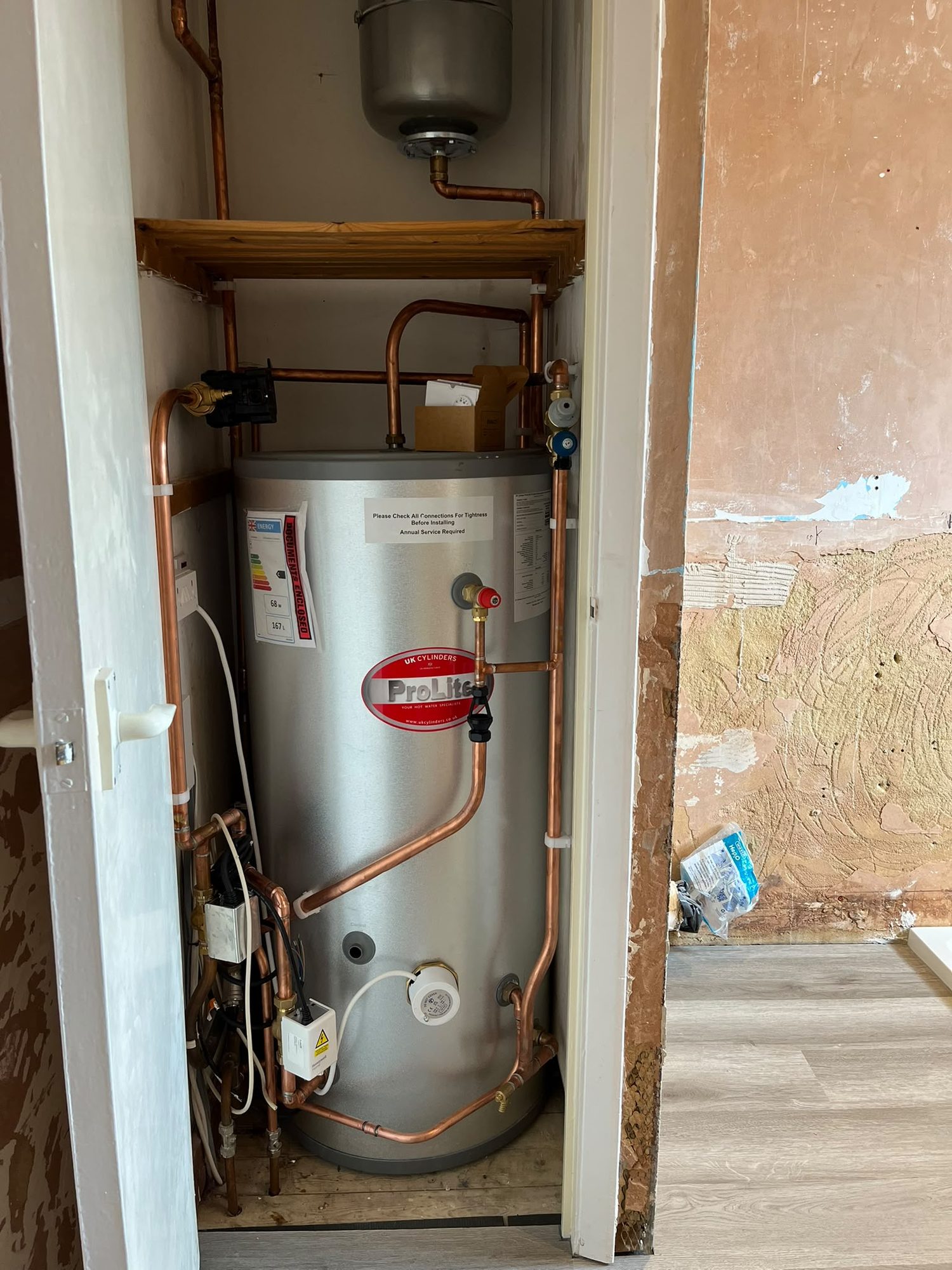
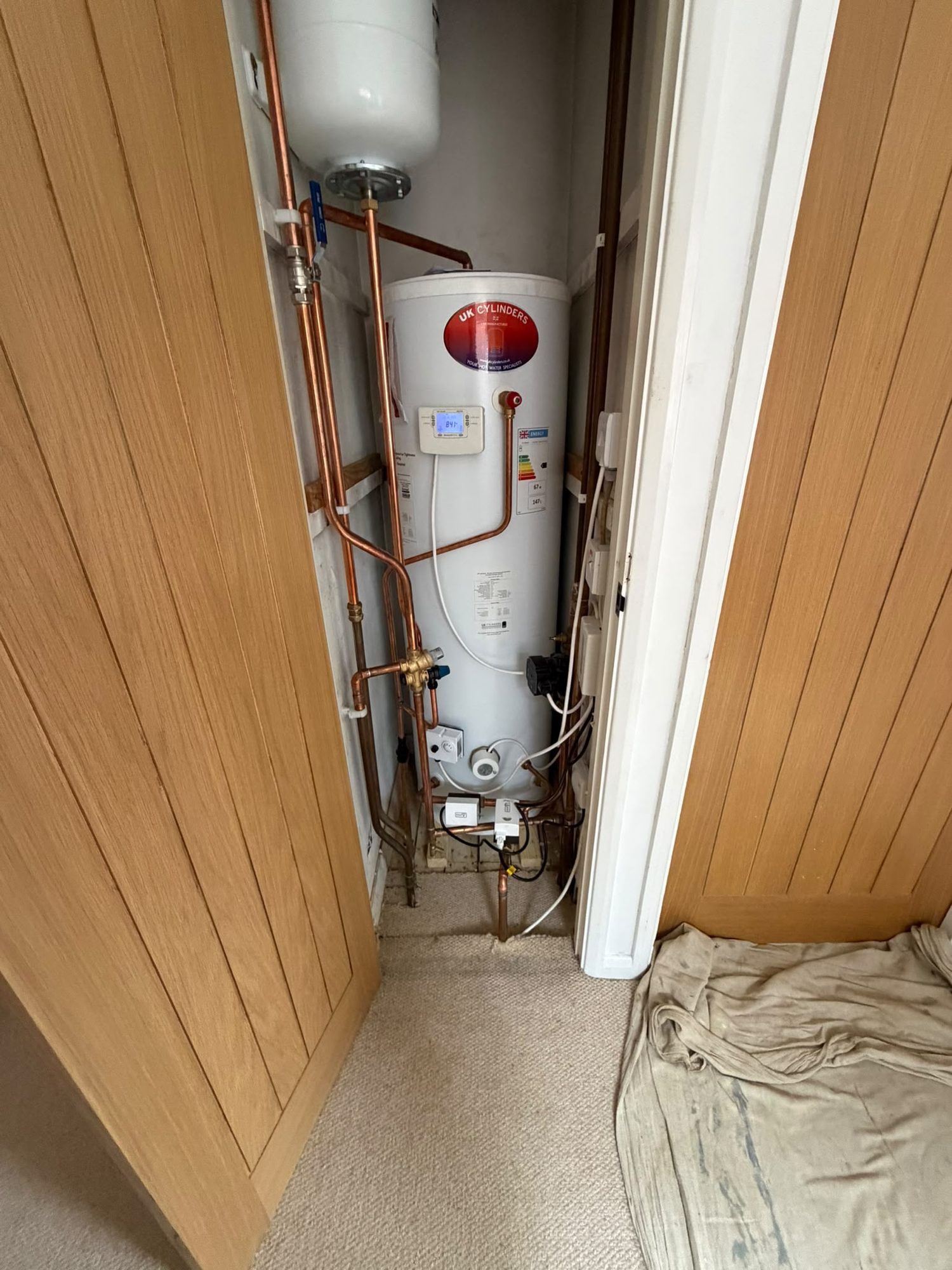
An unvented cylinder carries multiple layers of protection: an expansion vessel to absorb the increase in volume as water heats, an expansion relief valve, a temperature and pressure relief valve, and a thermal cut-out. These are the reason the system is safe, and they must all be present, correctly specified and correctly set.
The discharge pipework from the relief valves has to be routed and terminated so that any discharge is safe and visible. Route feasibility is one of the main practical constraints on where a cylinder can be positioned, and we establish it at survey rather than on installation day.
Incoming mains flow and pressure also need checking. An unvented cylinder cannot deliver more flow than the mains supplies, so where the incoming supply is genuinely poor we say so before you commit to the conversion.
Controls, temperature and legionella
Cylinder temperature is controlled by a thermostat and, in most systems, a motorised valve that lets the boiler serve heating and hot water separately. Stored water is held at a temperature that manages bacterial risk, with thermostatic blending used at outlets where scald risk needs controlling.
Zoned controls let hot water be heated on its own schedule rather than only when the heating runs, which is both more comfortable and cheaper across the year.
Servicing, replacement and combined projects
Unvented cylinders should be serviced periodically by a G3 qualified engineer: checking the expansion vessel charge, testing the relief valves, inspecting the discharge arrangement and checking the immersion and thermostat. Skipping it is how a safe system quietly stops being one.
Cylinder replacement is often best combined with a boiler change or a bathroom project, since the pipework, controls and hot water demand are all being reconsidered at the same time. Recent customers have had exactly that: a new boiler, hot water cylinder and water softener together, and a new cylinder with a full bathroom installation.
Our work is domestic, across Epping, Harlow, Bishops Stortford, Chelmsford and the surrounding towns, on natural gas systems.